Choosing the right office space is one of the most important decisions when setting up or expanding a business. But beyond location, rent, and carpet area, there is another factor that can significantly impact your investment: the condition in which the commercial property is handed over.
Should you lease a bare-shell office and build everything from scratch? Should you choose a warm-shell property with basic infrastructure already installed? Or is a fully furnished office a better option?
Each option comes with different costs, timelines, flexibility, and operational advantages.
For businesses planning to lease commercial office space in 2026, understanding the difference between bare shell, warm shell, and furnished offices can help avoid unexpected expenses and make better long-term decisions.
In this guide, we compare all three options, explain their costs, highlight their advantages and disadvantages, and help you decide which office format is right for your business.
1. What Is a Bare-Shell Office?
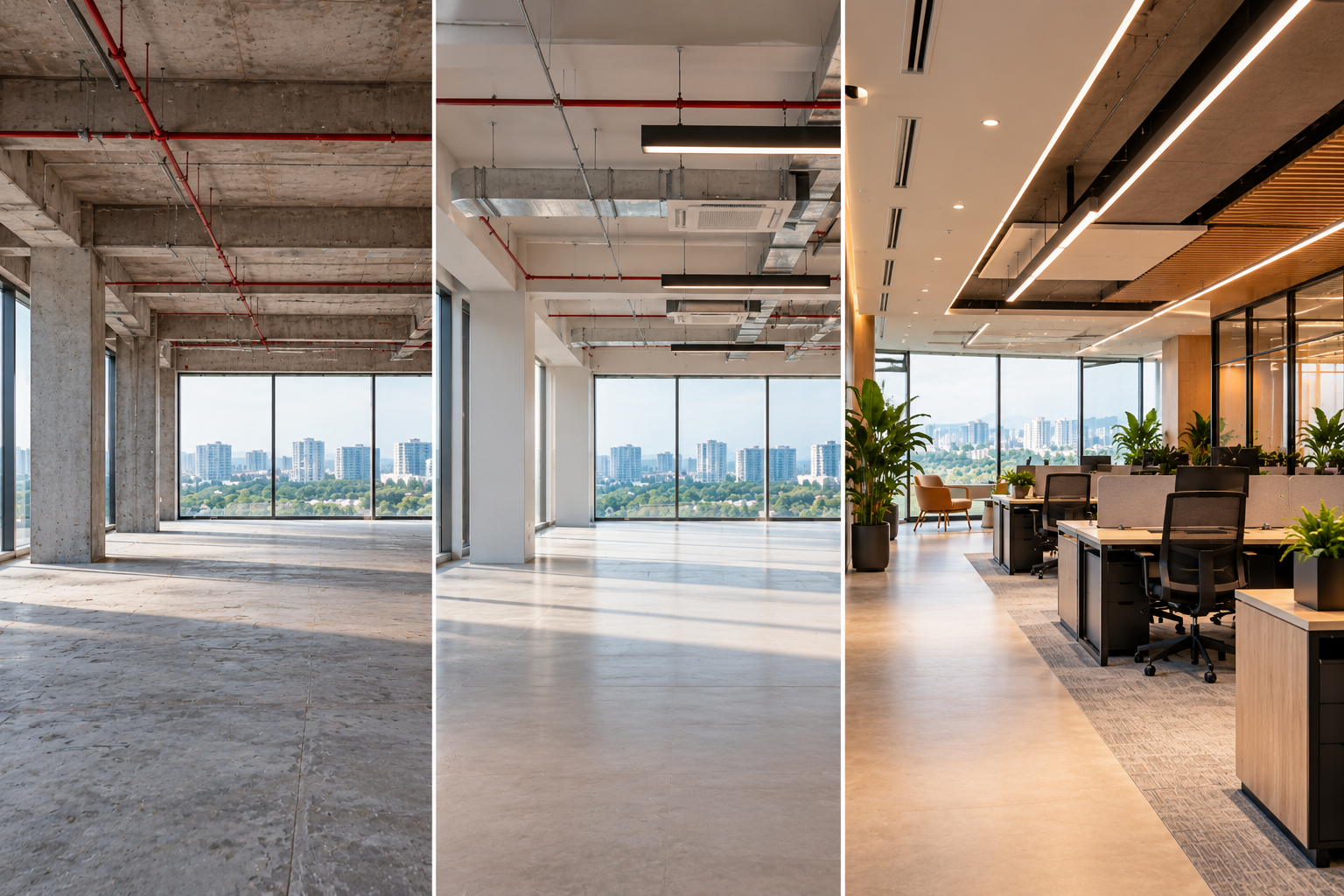
A bare-shell office is a commercial property handed over in an unfinished condition, with minimal internal finishing and infrastructure.
Essentially, you receive an empty commercial space and are responsible for developing it into a functional workplace.
Depending on the building, a bare-shell office may include the structural framework, external walls, windows, basic utility connections, and common building infrastructure.
However, most interior requirements need to be planned and executed separately.
What is typically included in a bare-shell office?
- Basic structural flooring or unfinished floor surface
- Concrete ceilings or exposed slabs
- External walls and windows
- Basic utility connections
- Common building facilities
- Core building services
What do you need to install?
- Flooring
- False ceiling
- Electrical wiring and lighting
- Air-conditioning systems or internal distribution
- Workstations and office furniture
- Glass partitions and cabins
- Reception and meeting rooms
- Pantry and storage areas
- Networking and IT infrastructure
Advantages of leasing a bare-shell office
- Complete design flexibility: You can design the office according to your company’s brand identity, employee requirements, and operational needs.
- Customised space planning: You have greater control over workstation layouts, meeting rooms, executive cabins, and collaborative areas.
- Control over material selection: You can choose materials, finishes, furniture, and fixtures according to your budget.
- Long-term suitability: Businesses planning to occupy a space for several years may benefit from developing an office specifically around their requirements.
Disadvantages of a bare-shell office
- Higher initial fit-out investment
- Longer time before employees can move in
- More contractors and vendors to coordinate
- Greater responsibility for infrastructure planning
- Potential delays due to procurement and approvals
A bare-shell office is generally suitable for businesses that want complete control over their workspace and have sufficient time and budget for a full office fit-out.
2. What Is a Warm-Shell Office?
A warm-shell office is a commercial space that has already undergone some basic finishing and infrastructure installation.
Unlike a bare-shell property, a warm-shell office is partially developed and requires additional interior work before it becomes fully operational.
The exact specifications can vary significantly between commercial buildings and landlords.
What is typically included in a warm-shell office?
- Basic flooring
- Finished walls
- Basic ceiling or exposed ceiling treatment
- Electrical provisions
- Air-conditioning infrastructure or provisions
- Finished washrooms, depending on the property
- Basic lighting or electrical points
- Utility connections
What may still need to be installed?
- Workstations and office chairs
- Meeting room furniture
- Executive cabins
- Glass partitions
- Reception counters
- Storage units
- Additional lighting
- Branding elements
- Networking and IT infrastructure
Advantages of leasing a warm-shell office
- Lower initial development effort: Some of the basic infrastructure is already available, reducing the amount of work required.
- Faster office setup: You can focus on furniture, partitions, branding, and finishing instead of developing the entire space.
- Better budget predictability: With some infrastructure already completed, it may be easier to estimate the remaining fit-out investment.
- Balance between flexibility and convenience: You can customise important areas without starting everything from scratch.
Disadvantages of a warm-shell office
- Limited flexibility compared to a bare-shell property
- Existing infrastructure may require modifications
- Some finishing choices may be restricted
- The quality of existing installations can vary
- You may end up paying to remove or modify unsuitable work
A warm-shell office is often a practical option for growing businesses that want a balance between customisation, cost, and faster occupancy.
3. What Is a Fully Furnished Office?
A fully furnished office is a commercial workspace that is already equipped with most of the essential furniture, infrastructure, and facilities required for business operations.
Depending on the property, it may be ready for immediate occupation or require only minor modifications.
What is typically included in a furnished office?
- Workstations and office chairs
- Executive cabins
- Meeting and conference rooms
- Reception furniture
- Flooring and ceiling
- Electrical and lighting systems
- Air-conditioning
- Pantry facilities
- Storage units
- Internet and networking provisions, depending on the agreement
Some furnished offices may also include access control, security systems, power backup, and shared amenities.
Advantages of leasing a furnished office
- Faster move-in: Businesses can start operations much sooner without waiting for a complete interior fit-out.
- Lower upfront fit-out investment: Most major furniture and interior expenses have already been addressed.
- Reduced project management: You do not need to coordinate a large number of interior contractors.
- Suitable for immediate expansion: Companies opening a new branch or setting up a temporary office can benefit from an existing setup.
Disadvantages of a furnished office
- Limited design flexibility
- Existing layouts may not suit your business
- Furniture quality may not meet expectations
- Modifications may require landlord approval
- The rent may be higher depending on the property and location
- You may pay for facilities that your business does not need
A furnished office is generally suitable for businesses prioritising speed, convenience, and minimal initial setup work.
4. Bare Shell vs Warm Shell vs Furnished Office: Key Differences
Let’s compare all three options side by side.
| Comparison Factor | Bare Shell | Warm Shell | Furnished Office |
|---|---|---|---|
| Property condition | Unfinished | Partially finished | Ready-to-use setup |
| Flooring | Usually unfinished | Generally available | Available |
| Ceiling | Usually unfinished | Basic or finished | Finished |
| Electrical | Basic provisions | Partially installed | Generally installed |
| Air-conditioning | May require installation | Basic infrastructure may exist | Generally available |
| Workstations | Not included | Usually not included | Generally included |
| Meeting rooms | Need to develop | Need to develop or modify | Generally available |
| Design flexibility | High | Moderate to high | Limited |
| Initial fit-out investment | High | Moderate | Low |
| Setup time | Longer | Moderate | Shorter |
| Customisation | Extensive | Moderate | Limited |
Note: These are general industry distinctions. Always verify the landlord’s technical specifications and written handover checklist before signing a lease.
5. How Much Does It Cost to Set Up Each Type of Office?
One of the biggest differences between bare-shell, warm-shell, and furnished offices is the amount of additional investment required before operations can begin.
The following are indicative office interior fit-out planning estimates for 2026.
| Office Type | Indicative Additional Fit-Out Cost |
|---|---|
| Bare Shell | ₹1,200–₹5,000+ per sq. ft. |
| Warm Shell | ₹800–₹3,500 per sq. ft. |
| Furnished Office | ₹0–₹800 per sq. ft. |
These are broad planning ranges, not fixed market quotations. Actual costs depend on the condition of the property, existing infrastructure, furniture requirements, material specifications, and the extent of customisation.
For a furnished office, the estimate represents potential modifications and upgrades rather than the rent or deposit.
Example: Cost comparison for a 5,000 sq. ft. office
Let’s assume you’re planning to lease a 5,000 sq. ft. commercial office.
| Office Type | Estimated Additional Fit-Out Investment |
|---|---|
| Bare Shell | ₹60 lakh–₹2.5 crore+ |
| Warm Shell | ₹40 lakh–₹1.75 crore |
| Furnished Office | ₹0–₹40 lakh |
The actual investment may be significantly lower or higher depending on the condition of the property and the required specifications.
For example, a warm-shell property with existing flooring, functional HVAC, and electrical infrastructure may require substantially less investment than one that needs major modifications.
The important point is to compare the total cost of occupancy rather than looking at the monthly rent alone.
6. How Long Does It Take to Make Each Office Operational?
Your move-in date can influence which type of office you should lease.
Here are indicative setup timelines:
| Office Type | Estimated Setup Time |
|---|---|
| Bare Shell | 8–16 weeks or longer |
| Warm Shell | 6–12 weeks |
| Furnished Office | 1–4 weeks |
These estimates depend on the amount of work required, procurement timelines, landlord permissions, and building restrictions.
Bare-shell office: Requires extensive design, infrastructure installation, flooring, ceiling, furniture, and finishing work.
Warm-shell office: Requires fewer infrastructure modifications, allowing businesses to focus on partitions, furniture, and customisation.
Furnished office: Requires relatively little work, provided the existing layout and facilities meet your requirements.
If your business has a strict relocation deadline, a furnished or suitable warm-shell property may be a more practical choice.
7. Which Office Type Should Startups, SMEs and Large Corporates Choose?
The right office format depends on your company’s stage, employee strength, budget, and long-term plans.
For Startups
Startups generally need to manage cash flow carefully while maintaining flexibility.
A furnished office or warm-shell property can be a practical starting point.
If you have a small team and expect significant changes in employee strength, avoiding a large upfront interior investment may make financial sense.
Recommended option: Furnished or warm shell.
For Growing SMEs
Growing businesses often require a balance between brand identity, employee comfort, and cost management.
A warm-shell office allows you to customise important areas while using existing infrastructure.
You can invest in quality workstations, meeting rooms, reception areas, and branding without developing the entire property from scratch.
Recommended option: Warm shell.
For Established Corporates
Established businesses often have specific requirements around employee experience, brand identity, security, technology, and space utilisation.
A bare-shell office offers greater flexibility to create a workspace designed around these requirements.
However, a warm-shell property may still be more economical if its existing infrastructure meets the company’s needs.
Recommended option: Bare shell or warm shell, depending on project requirements.
8. Five Things to Check Before Leasing a Commercial Office
Before finalising your lease agreement, evaluate more than just the property condition.
Here are five important things to check.
1. Verify the Actual Handover Specifications
Do not assume that every landlord uses the same definition of bare shell or warm shell.
Ask for a written list of what is included in the handover.
Check flooring, electrical provisions, HVAC systems, washrooms, ceilings, fire safety provisions, and utility connections.
2. Inspect Existing Infrastructure
If you’re considering a warm-shell or furnished office, arrange a technical inspection.
Check the condition and capacity of electrical systems, air-conditioning, plumbing, networking, and other essential installations.
Existing infrastructure may need replacement or upgrades if it does not meet your business requirements.
3. Understand Landlord Permissions
Some commercial buildings have restrictions on:
- Civil modifications
- Electrical changes
- HVAC alterations
- Glass partitions
- Signage and branding
- Working hours for contractors
- Material transportation
Understand these restrictions before signing the lease.
4. Calculate Total Cost of Occupancy
Your financial calculation should include more than monthly rent.
Consider:
- Monthly rental
- Security deposit
- Maintenance charges
- Interior fit-out investment
- Furniture and equipment
- Electricity and utility expenses
- GST and applicable taxes
- Restoration obligations at the end of the lease
This gives you a more realistic understanding of the total investment.
5. Check the Lease Period
If you’re planning to invest heavily in a bare-shell office, make sure the lease duration supports that investment.
A short lease with substantial fit-out expenses can create financial pressure if you need to relocate before recovering the value of your investment.
Also clarify ownership of fixed installations, removal rights, reinstatement requirements, and any rent-free fit-out period in the lease agreement.
9. Is a Bare-Shell Office Actually Cheaper in the Long Run?
Not necessarily.
A bare-shell office may offer a lower initial rental rate in some situations, but the business must independently invest in developing the workspace.
Similarly, a furnished office may have a higher rental cost but eliminate a significant upfront fit-out investment.
The right financial comparison should consider the total cost over your intended lease period.
For example, consider two properties:
- Property A: Lower monthly rent, but requires substantial interior investment.
- Property B: Higher monthly rent, but already includes furniture and essential infrastructure.
Property A may be more economical for a business planning long-term occupancy, while Property B may be financially preferable for a company that needs to move quickly or expects to relocate in a few years.
The best option is the one that provides the lowest total cost for your actual business requirements, not necessarily the lowest monthly rent.
10. Final Checklist: What Should You Lease?
Before making your decision, consider the following:
| Your Business Requirement | Recommended Office Type |
|---|---|
| Complete design freedom | Bare Shell |
| Customised corporate workspace | Bare Shell |
| Balance between cost and customisation | Warm Shell |
| Faster office setup | Furnished Office |
| Minimal upfront investment | Furnished Office |
| Growing team with changing requirements | Warm Shell |
| Long-term customised workspace | Bare Shell or Warm Shell |
| Temporary or immediate expansion | Furnished Office |
There is no universally correct choice. Your decision should reflect your business priorities, financial position, occupancy plans, and relocation timeline.
Frequently Asked Questions (FAQs)
1. What is the difference between a bare-shell and warm-shell office?
A bare-shell office is generally handed over as an unfinished commercial space requiring extensive interior and infrastructure work. A warm-shell office already has some basic finishing and infrastructure, such as flooring, electrical provisions, or air-conditioning infrastructure.
2. Is a warm-shell office cheaper than a bare-shell office?
A warm-shell office often requires less additional fit-out investment because some infrastructure is already installed. However, the overall cost depends on the rental rate, existing installation quality, and modifications required.
3. Is a furnished office worth leasing?
A furnished office can be worth leasing if you want to start operations quickly and avoid significant upfront interior investment. However, evaluate the furniture quality, layout, maintenance responsibilities, and rental premium before committing.
4. Which office type is best for a startup?
For many startups, a furnished or warm-shell office is practical because it reduces initial setup time and capital expenditure. The right choice depends on team size, budget, and expected business growth.
5. Can I customise a warm-shell office?
Yes. Warm-shell offices can generally be customised through furniture, partitions, branding, lighting, and other interior modifications. However, structural and infrastructure changes may require landlord or building management approval.
6. How much does it cost to convert a bare-shell office into a fully functional workspace?
Indicative fit-out costs can range from ₹1,200 to ₹5,000+ per sq. ft., depending on materials, furniture, infrastructure, and design specifications.
7. How long does it take to set up a bare-shell office?
A typical commercial office fit-out may take around 8–16 weeks or longer, depending on the office size, project complexity, procurement, and approvals.
8. What should I check before signing a commercial office lease?
Check the handover specifications, electrical capacity, HVAC provisions, building permissions, maintenance charges, lease duration, fit-out period, and restoration obligations.
Conclusion: Choose an Office That Works for Your Business
Choosing between a bare-shell, warm-shell, and furnished office is not simply about selecting a property with more or fewer interiors.
It is about understanding how much you want to invest, how quickly you need to move in, how much design flexibility you require, and how long you intend to occupy the space.
A bare-shell office provides maximum creative freedom. A warm-shell office offers a balance between flexibility and convenience. A furnished office makes it easier to start operations with minimal setup.
Before signing a lease, evaluate the property condition, estimate the additional fit-out investment, and compare the total cost of occupancy over your intended lease period.
Planning to lease a new office?
Whether you’re considering a bare-shell, warm-shell, or furnished workspace, the right interior planning can help you make better use of your space and avoid unnecessary expenses.
Get your office evaluated, understand the fit-out requirements, and create a workspace that supports your business goals.