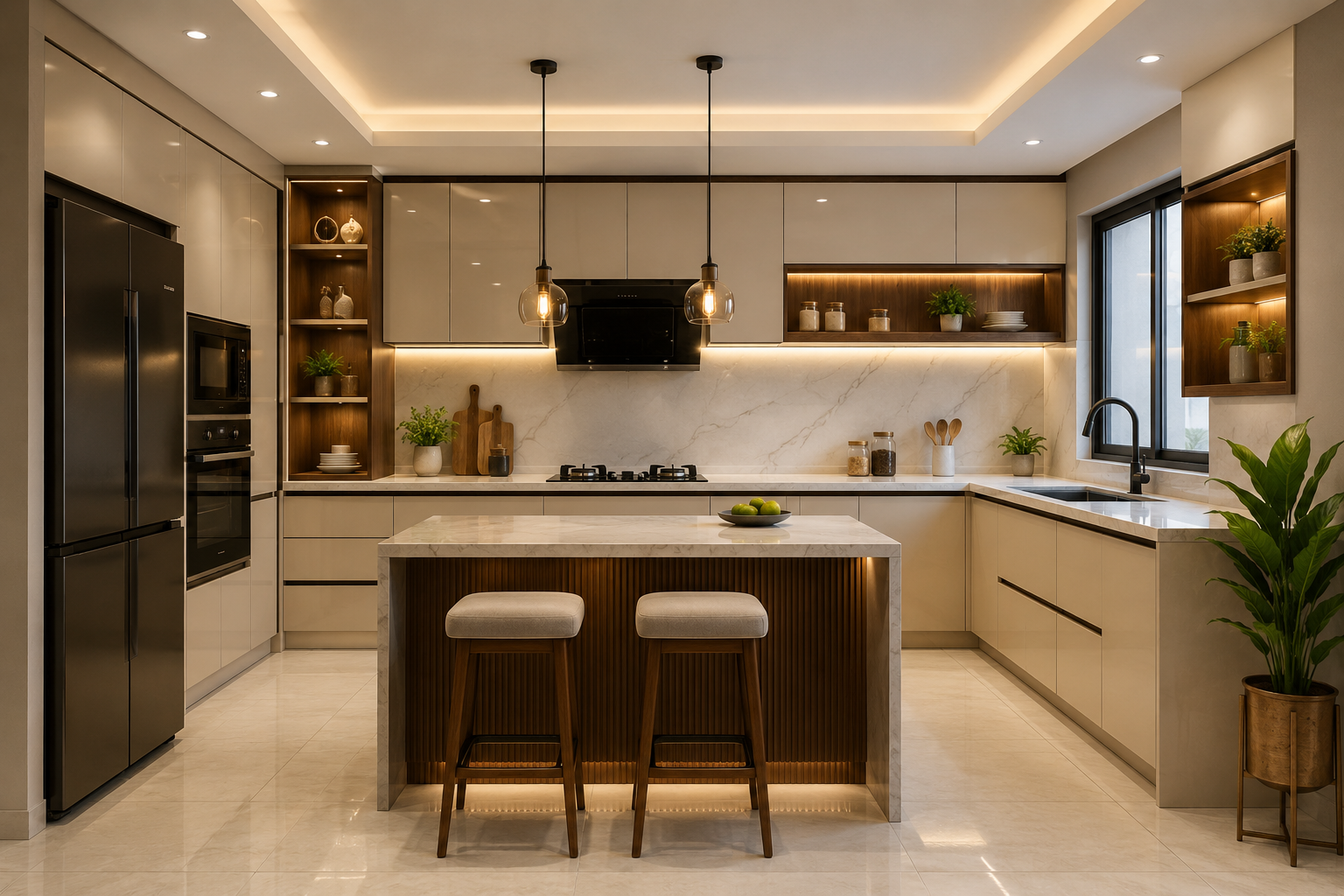
Planning a new kitchen or renovating an existing one? One of the first questions homeowners ask is: “How much does a modular kitchen cost per sq. ft. in 2026?”
The answer isn’t as straightforward as multiplying the kitchen area by a fixed rate.
A modular kitchen’s price depends on several factors, including the size and layout of the kitchen, carcass material, shutter finish, hardware, countertop, storage accessories, installation and even your location.
In 2026, a mid-range modular kitchen in India can typically cost around ₹1,800–₹2,800 per sq. ft., while budget kitchens may start around ₹1,200–₹1,800 per sq. ft. and premium specifications can reach ₹2,500–₹5,500+ per sq. ft. depending on the materials and finishes selected.
But before you start calculating your budget, there’s one important thing you need to understand:
The quoted “per sq. ft.” price may not include everything.
Let’s break down the actual cost of a modular kitchen in 2026.
What Is the Average Modular Kitchen Cost Per Sq. Ft. in 2026?
Here’s a broad estimate for Indian homes:
| Kitchen Type | Approx. Cost Per Sq. Ft. |
|---|---|
| Budget | ₹1,200–₹1,800 |
| Mid-Range | ₹1,800–₹2,800 |
| Premium | ₹2,500–₹5,500+ |
| Luxury | ₹5,500+ |
These are indicative figures and can vary significantly depending on the city, materials, brand, kitchen layout and scope of work.
For example, a simple laminate kitchen with standard hardware will cost considerably less than a kitchen featuring BWP plywood, acrylic or PU shutters, premium channels, quartz countertops and imported accessories.
Why Does the Cost Vary So Much?
A modular kitchen is made up of several components rather than one product.
Your final quotation can include:
- Carcass or cabinet boxes
- Shutters
- Hardware
- Drawers and channels
- Storage accessories
- Countertop
- Backsplash
- Sink and faucet
- Hob and chimney
- Electrical and plumbing work
- Installation
- Transportation
- GST
This is why two kitchens with almost the same dimensions can have very different prices.
1. Carcass Material
The carcass is the internal structure or box of your kitchen cabinets. It provides the foundation for the entire kitchen.
The material you choose here has a major impact on durability and cost.
Particle Board
Particle board is generally one of the more economical options.
It can work for budget-conscious projects, particularly in areas that don’t experience significant moisture. However, it isn’t generally the first choice for wet kitchen zones.
MDF / HDHMR
MDF and HDHMR can provide a smoother surface and are commonly used for certain kitchen applications.
HDHMR, in particular, is often considered for areas where better moisture resistance is required than conventional MDF.
BWR / BWP Plywood
Plywood is a popular choice for Indian kitchens because kitchens regularly experience moisture, heat and steam.
BWR and BWP plywood are generally positioned as more durable options, with BWP being particularly suitable for areas exposed to moisture. Current 2026 material guides place BWP plywood above MDF and particle board in cost.
Tip: Don’t select the carcass material based only on price. Ask your designer or contractor exactly which board is being used and where.
2. Shutter Finish
The shutters are the visible front panels of your cabinets, so the finish has a significant impact on both appearance and price.
Some common options include:
Laminate
Laminate remains one of the most practical choices for Indian kitchens.
It offers:
- A wide variety of colours and textures
- Good everyday durability
- Easy maintenance
- Relatively affordable pricing
For homeowners looking for a balance between aesthetics, durability and budget, laminate is often a strong choice.
Acrylic
Acrylic gives the kitchen a glossy, contemporary appearance.
It can make smaller kitchens appear brighter and more spacious, but it generally costs more than laminate and can be more prone to showing fingerprints and scratches.
PU Finish
PU or polyurethane finishes are generally considered a premium option.
They provide a smooth, sophisticated appearance and offer greater flexibility in colours and finishes. However, they can substantially increase the overall kitchen budget. 2026 market estimates place PU kitchens among the more expensive finish categories.
Membrane
Membrane finishes can be another relatively economical option, particularly for certain profiles and designs.
However, the suitability of any finish should be evaluated based on the kitchen environment, especially in areas with high humidity and heat.
3. Hardware Can Make a Big Difference
A kitchen isn’t just about boards and shutters.
The hardware determines how your kitchen actually functions every day.
This includes:
- Hinges
- Drawer channels
- Tandem drawers
- Corner mechanisms
- Tall-unit accessories
- Bottle pull-outs
- Pantry units
- Soft-close systems
- Lift-up mechanisms
Basic hardware can keep the initial quotation low, while premium branded hardware can significantly increase the cost.
For example, replacing standard drawers with premium soft-close systems throughout the kitchen can add a substantial amount to the final quotation.
Don’t compromise heavily on hardware just to save money.
A beautiful kitchen with poor-quality hinges and channels can become frustrating to use within a few years.
4. Countertop Cost
The countertop is another major component of your kitchen budget.
Common choices include:
Granite
Granite remains one of the most popular options because it offers good durability at a relatively reasonable price.
Quartz
Quartz provides a more uniform and contemporary appearance and is available in a wide range of colours and patterns.
It generally costs more than standard granite.
Other Premium Surfaces
Depending on the project, homeowners may also consider materials such as Corian, sintered stone or other premium surfaces.
Your countertop cost depends on:
- Material
- Thickness
- Edge profile
- Cut-outs
- Sink installation
- Backsplash requirements
- Brand
Current 2026 estimates show granite and quartz occupying different price bands, with premium quartz costing substantially more than basic granite.
5. Kitchen Layout Affects the Budget
The layout of your kitchen can have a major impact on the amount of cabinetry required.
Straight Kitchen
A straight kitchen is usually the simplest configuration.
It works well for compact apartments and generally requires less cabinetry and hardware.
L-Shaped Kitchen
An L-shaped kitchen provides more storage and working space and is one of the most popular layouts for Indian homes.
Because it has more cabinetry than a basic straight kitchen, the overall cost is usually higher.
Parallel Kitchen
Also known as a galley kitchen, this layout has cabinets on two opposite walls.
It can provide excellent storage but requires more cabinetry.
U-Shaped Kitchen
A U-shaped kitchen offers extensive storage and countertop space.
However, it also requires significantly more cabinetry and hardware, increasing the overall cost.
Island Kitchen
An island can become a major additional cost depending on its size and functionality.
An island may include:
- Additional cabinets
- Drawers
- Countertop
- Electrical points
- Seating
- Sink or hob
So when planning an island kitchen, don’t look only at the size of the room. Look at how many additional cabinets and services you’re adding.
6. Size Doesn’t Always Mean Floor Area
This is where many homeowners get confused.
A contractor may quote a price per sq. ft., while another designer may quote per running foot.
These are not necessarily the same calculation.
For example, kitchen cabinetry is often measured based on the length of the cabinets rather than the floor area of the room.
A 100 sq. ft. kitchen doesn’t automatically mean you need 100 sq. ft. of cabinetry.
The number of base cabinets, wall cabinets, tall units, lofts and accessories determines the actual amount of work.
Some 2026 Indian pricing references therefore quote complete cabinetry on a running-foot basis, with laminate, acrylic and PU kitchens occupying very different price bands.
Always ask the designer what exactly their “per sq. ft.” measurement refers to.
7. What Does a ₹2,500 Per Sq. Ft. Kitchen Actually Include?
This is one of the most important questions to ask before accepting a quotation.
Suppose someone tells you:
“Our modular kitchen starts at ₹2,500 per sq. ft.”
Ask:
- Does this include the carcass?
- Which plywood or board is being used?
- What is the shutter finish?
- Are hinges included?
- Are drawer channels included?
- Is soft-close hardware included?
- Are baskets included?
- Is the countertop included?
- Is the sink included?
- Is installation included?
- Is transportation included?
- Is GST included?
A low-looking per-square-foot price can become much higher once additional components are added.
Some industry estimates suggest homeowners should budget an additional 25–35% over a basic per-square-foot cabinetry quote when several commonly excluded components and upgrades are added.
8. Approximate Modular Kitchen Budget by Size
As a broad planning guide, you can think about your budget like this:
| Kitchen Size / Home | Indicative Mid-Range Budget |
|---|---|
| Compact 1BHK kitchen | ₹1.5–₹2.5 lakh |
| Typical 2BHK kitchen | ₹2.5–₹4 lakh |
| Larger 3BHK kitchen | ₹4–₹6.5 lakh |
| Large / Villa kitchen | ₹6 lakh onwards |
These figures can move significantly depending on the layout, finish, hardware, countertop and appliances.
For instance, an L-shaped kitchen with laminate shutters and standard hardware can be considerably more affordable than the same layout with acrylic or PU shutters and premium storage accessories.
9. Modular Kitchen Cost in Major Indian Cities
Your location can also influence the final price.
Labour, transportation, installation costs and local demand can all affect the quotation.
For example, 2026 estimates for Bengaluru show semi-modular kitchen rates ranging from approximately ₹2,275 per sq. ft. for some laminate specifications to around ₹4,550 per sq. ft. for PU finishes, with fully modular configurations potentially costing more.
Similarly, broader 2026 estimates show noticeable differences between cities such as Mumbai, Delhi NCR, Bengaluru, Pune, Chennai and Hyderabad.
Therefore, avoid comparing a quote from one city directly with another without checking the exact specifications.
10. Hidden Costs You Should Watch Out For
One of the biggest mistakes homeowners make is looking only at the cabinet price.
Additional costs may include:
Electrical Work
Moving switches, adding sockets or creating dedicated points for appliances can increase the cost.
Plumbing
Sink relocation, water lines and drainage modifications may be charged separately.
Civil Work
Removing an existing countertop, demolishing old cabinets or modifying walls can add to the project cost.
Appliances
Hob, chimney, refrigerator, dishwasher, microwave and built-in ovens may not be included in the modular kitchen quote.
Sink and Faucet
These can range from basic to premium and should be clearly mentioned in the quotation.
Installation
Some companies include installation while others may quote it separately.
GST
Always check whether the quoted price is inclusive or exclusive of GST.
How to Reduce Your Modular Kitchen Cost Without Compromising Quality
You don’t necessarily need to choose the cheapest materials to control your budget.
Instead, spend money where it matters.
1. Choose laminate for most shutters
Laminate provides a strong balance between appearance, maintenance and cost.
2. Upgrade hardware selectively
Use premium hardware for frequently used drawers and mechanisms rather than upgrading every single component.
3. Prioritise the wet zones
Invest in better moisture-resistant materials around the sink and other high-moisture areas.
4. Avoid unnecessary accessories
Not every kitchen needs every pull-out, corner mechanism or fancy storage system.
Choose accessories based on how you actually use the kitchen.
5. Keep the layout practical
A complicated layout with multiple corners, curves and additional units can increase costs.
A well-planned simple layout can look just as premium.
6. Compare complete quotations
Don’t compare only the headline price.
Ask at least two or three designers for a component-wise quotation with the same specifications.
Questions to Ask Before Finalising Your Modular Kitchen
Before signing the contract, ask your designer these questions:
- What board material are you using?
- What grade of plywood is included?
- What shutter finish is included?
- Which hardware brand is being used?
- Are soft-close hinges included?
- Are drawers and baskets included?
- Is the countertop included?
- Is the sink included?
- Is installation included?
- Is GST included?
- Are electrical and plumbing modifications included?
- What is the warranty?
- What is the expected installation timeline?
- What happens if a component needs replacement?
Getting these answers in writing can prevent unpleasant surprises later.
Final Thoughts: What Should You Budget for a Modular Kitchen in 2026?
There is no single “correct” modular kitchen price per sq. ft.
For 2026, a reasonable starting point is:
Budget: ₹1,200–₹1,800/sq. ft.
Mid-range: ₹1,800–₹2,800/sq. ft.
Premium: ₹2,500–₹5,500+/sq. ft.
But these figures should be treated as planning ranges rather than fixed market prices.
The most important thing is to understand exactly what is included in the quotation.
A ₹2,000 per sq. ft. kitchen with limited inclusions may ultimately cost more than a ₹2,500 per sq. ft. quotation that includes better hardware, countertop, installation and accessories.
So instead of asking only:
“What is your modular kitchen price per sq. ft.?”
ask:
“What exactly do I get for that price?”
That one question can make your kitchen budgeting significantly more accurate and help you choose a kitchen that looks good, functions well and lasts for years.