Designing a home or commercial space is exciting, but managing everything involved can quickly become overwhelming. From choosing the right materials and finalising designs to coordinating contractors, electricians, carpenters, painters, and vendors, an interior project can involve dozens of moving parts.
This is where turnkey interior design services come in.
A turnkey interior design service offers an end-to-end solution where one interior design company takes responsibility for the project — from the initial concept and design to execution, installation, and final handover.
Instead of coordinating multiple vendors yourself, you work with one team responsible for bringing the entire design to life.
But what exactly does turnkey interior design include? How does the process work? How much does it cost in India? And is it the right choice for your project?
Let’s break it down.
What Is Turnkey Interior Design?
Turnkey interior design is an end-to-end interior solution in which the design company manages the project from the initial planning stage through execution and handover.
The term “turnkey” essentially means that the space is delivered ready to use.
Depending on the company and project scope, a turnkey interior package can include:
- Space planning
- Interior design and 3D visualisation
- Civil work
- Electrical work
- Plumbing
- False ceiling
- Flooring
- Painting
- Carpentry
- Modular kitchens
- Wardrobes
- Furniture
- Lighting
- Window treatments
- Wallpaper and wall finishes
- Décor and accessories
- Installation
- Project management
- Final cleaning and handover
The exact scope varies from company to company, so it is important to understand what is included before signing a contract.
How Does Turnkey Interior Design Work?
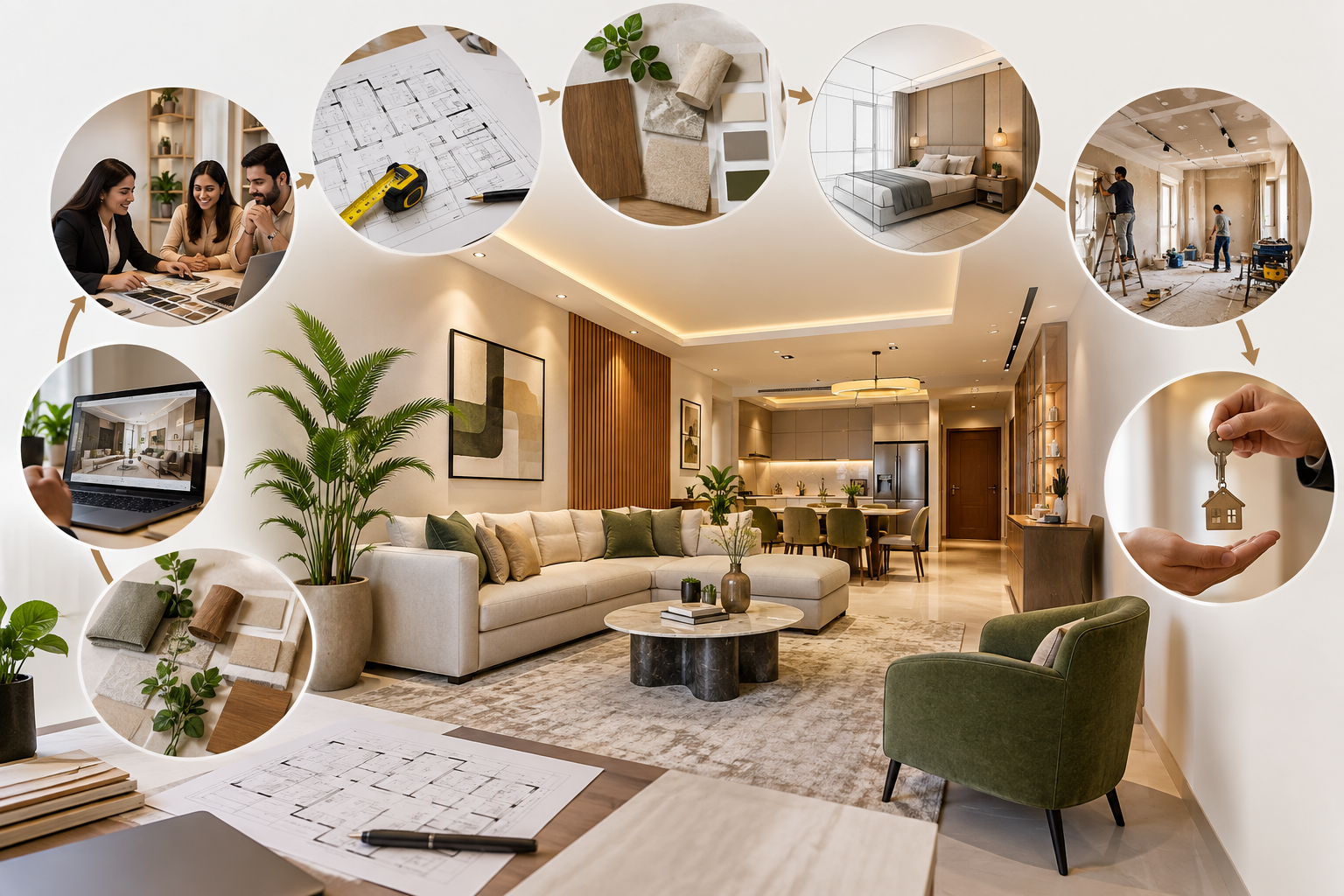
A typical turnkey interior project follows a structured process.
1. Initial Consultation
The process usually begins with a consultation between the client and the interior design team.
The designer understands:
- Your requirements
- Lifestyle and preferences
- Budget
- Space dimensions
- Functional requirements
- Preferred design style
- Timeline
- Material preferences
For commercial projects, the discussion may also cover branding, customer experience, employee requirements, operational workflow, and industry-specific needs.
2. Site Measurement and Assessment
The design team visits the property to understand the actual space.
They assess factors such as:
- Dimensions
- Existing electrical points
- Plumbing lines
- Structural elements
- Windows and doors
- Natural lighting
- Ventilation
- Ceiling height
- Existing flooring
- Site conditions
Accurate measurements at this stage help avoid expensive changes during execution.
3. Concept Development
Once the requirements are understood, the designers develop a design direction.
This can include:
- Mood boards
- Colour palettes
- Material selections
- Furniture concepts
- Lighting concepts
- Space planning
The objective is to establish the overall visual and functional direction before detailed execution begins.
4. 3D Designs and Visualisation
The next stage involves creating detailed drawings and 3D visualisations.
These allow you to understand what the finished space could look like before construction begins.
Depending on the project, you may receive:
- 3D room views
- Furniture layouts
- Ceiling plans
- Electrical layouts
- Elevations
- Detailed drawings
- Material specifications
This stage is particularly important because design changes are generally easier and less expensive to make before execution starts.
5. Cost Estimation and Scope Finalisation
After the design is approved, the interior company prepares a detailed quotation.
The quotation should ideally specify:
- Work items
- Materials
- Brands
- Quantities
- Specifications
- Labour
- Installation
- Taxes
- Project management charges
- Exclusions
A detailed scope helps prevent misunderstandings later.
6. Material Selection
The client and design team finalise the materials required for the project.
These can include:
- Plywood or MDF
- Laminates
- Veneers
- Hardware
- Tiles
- Flooring
- Paint
- Lighting
- Sanitaryware
- Countertops
- Fabrics
- Glass
- Decorative finishes
The choice of materials has a significant impact on both the appearance and final project cost.
7. Execution Begins
Once the scope, design, and commercial terms are approved, execution begins.
Depending on the project, the execution sequence may include:
Civil work → Electrical & plumbing → False ceiling → Flooring → Carpentry → Painting → Lighting → Furniture → Fixtures → Décor → Final finishing
A project manager or site team typically coordinates different contractors and vendors.
8. Quality Checks and Installation
As work progresses, the project team monitors quality and ensures that execution follows the approved designs and specifications.
This may include checking:
- Carpentry finishing
- Alignment
- Paint quality
- Electrical installation
- Hardware
- Plumbing
- Lighting
- Flooring
- Furniture installation
Regular quality checks can help identify issues before they become expensive to fix.
9. Final Handover
Once the work is completed, the site goes through a final inspection.
The team addresses pending corrections or “snag” items before handing over the completed space.
The objective is to provide the client with a finished space that is ready for use.
What Is Included in a Turnkey Interior Package?
There is no universal turnkey package. Every company defines its scope differently.
However, a residential turnkey interior project can commonly include the following.
| Service | Usually Included? |
|---|---|
| Interior Design | Yes |
| 3D Visualisation | Usually |
| Project Management | Usually |
| Modular Kitchen | Usually |
| Wardrobes | Usually |
| False Ceiling | Often |
| Electrical Work | Often |
| Painting | Often |
| Flooring | Depends on scope |
| Plumbing | Depends on scope |
| Furniture | Depends on package |
| Décor | Depends on package |
| Appliances | Usually optional |
| Civil Modifications | Project-dependent |
Always ask for a written scope of work instead of assuming something is included because a package is called “turnkey.”
How Much Does Turnkey Interior Design Cost in India?
The cost of turnkey interiors varies considerably depending on the property, city, size, materials, design complexity, and scope of work.
For residential interiors in India, projects can broadly range from ₹1,500 to ₹5,000+ per sq. ft. depending on the level of customisation and specifications.
For example, a 1,000 sq. ft. home could potentially have an interior budget ranging from approximately:
₹15 lakh to ₹50 lakh+
However, this is only a broad illustration, not a standard market rate.
A luxury project using premium materials, imported hardware, custom furniture, high-end lighting, and extensive civil modifications can cost significantly more.
Major factors affecting cost include:
1. Size of the property
Larger homes generally require more materials, labour, furniture, and installation.
2. Material quality
The difference between economy, mid-range, and premium materials can significantly affect the overall budget.
3. Customisation
Custom furniture and specialised designs generally cost more than standard modular solutions.
4. Civil work
Wall modifications, flooring changes, plumbing relocation, electrical changes, and other structural or civil work can increase project costs.
5. Hardware
Kitchen and wardrobe hardware can make a substantial difference in the final price.
6. City and labour costs
Interior costs can vary significantly between cities because of differences in labour, logistics, real estate, and vendor costs.
7. Design complexity
Minimal designs typically require fewer materials and simpler execution compared with highly detailed or luxury interiors.
Turnkey Interior Design vs Traditional Interior Contracting
One of the biggest advantages of turnkey interiors is centralised project management.
With a traditional approach, a homeowner might have to coordinate:
- Architect
- Interior designer
- Carpenter
- Electrician
- Painter
- Plumber
- Flooring contractor
- Furniture vendor
- Lighting vendor
With a turnkey company, most of these responsibilities are managed by a single team.
Traditional approach
Client → Multiple vendors → Multiple timelines → Multiple payments → Client coordination
Turnkey approach
Client → Turnkey interior company → Design + Execution + Vendors + Project Management
This can make the process considerably easier for clients who don’t have the time or experience to manage multiple contractors.
What Are the Advantages of Turnkey Interior Design?
1. One Point of Contact
Instead of communicating with several contractors, you generally have one primary team managing the project.
This simplifies communication.
2. Better Coordination
Interior projects involve multiple activities that need to happen in the right sequence.
For example, electrical work needs to be planned before certain walls and ceilings are closed.
A dedicated project management team can coordinate these dependencies.
3. Better Time Management
Because one company manages different stages of the project, scheduling can be easier than independently coordinating several contractors.
However, timelines still depend on approvals, material availability, site conditions, and the complexity of the project.
4. Design and Execution Stay Connected
When the same organisation handles both design and execution, the execution team has access to the approved design intent and specifications.
This can reduce communication gaps between designers and contractors.
5. Budget Visibility
A properly structured turnkey contract can provide a consolidated view of the project’s expected cost.
This makes budgeting easier compared with collecting separate quotations from multiple vendors.
6. Accountability
When multiple contractors are involved, determining responsibility for an issue can become complicated.
With a turnkey provider, the contract can establish one primary point of accountability for the agreed scope.
What Are the Disadvantages of Turnkey Interior Design?
Turnkey does not automatically mean cheaper or better for every project.
There are a few things you should consider.
Higher Initial Cost
A turnkey company is providing design, procurement, coordination, labour, and project management. These services are reflected in the overall project cost.
Less Direct Vendor Control
Some homeowners prefer personally selecting every vendor and negotiating individual prices. A turnkey model provides less direct control over individual contractor relationships.
Scope Matters
A low turnkey quotation may exclude important items.
For example, one company may include electrical work while another may charge it separately.
Always compare scope, not just price.
Vendor Selection
The quality of the final result depends heavily on the company’s design team, contractors, materials, supervision, and quality-control process.
When Does Turnkey Interior Design Make Sense?
Turnkey interiors can be particularly useful when:
You Have Limited Time
If you have a demanding job or business and don’t want to spend your evenings coordinating contractors, turnkey execution can reduce your involvement.
You Want a Single Team
If you prefer having one team responsible for design, procurement, execution, and coordination, turnkey can be a practical model.
You Are Doing a Complete Renovation
Large-scale renovations involve many trades and dependencies. Centralised project management can simplify the process.
You Are Moving Into a New Home
For new apartments or villas, a turnkey solution can help coordinate the entire interior fit-out before you move in.
You Are Setting Up a Commercial Space
Offices, retail stores, restaurants, clinics, and other commercial spaces often have strict timelines. A single execution partner can simplify coordination.
When Might Turnkey Interiors Not Be Necessary?
Turnkey may not be required if your project is very small.
For example, if you only want:
- A wardrobe
- A TV unit
- A false ceiling
- A fresh coat of paint
- A few pieces of furniture
Hiring separate specialists may be sufficient.
The right approach depends on the scale, complexity, budget, and amount of coordination your project requires.
Questions to Ask Before Hiring a Turnkey Interior Company
Before signing a contract, ask these questions:
1. What exactly is included?
Ask for a detailed scope of work.
2. Which brands and materials will be used?
Don’t settle for vague descriptions such as “premium plywood” or “high-quality hardware.”
Ask for specifications.
3. Is project management included?
Confirm who will supervise the site.
4. What is the estimated timeline?
Ask for project milestones rather than only a final completion date.
5. How are changes handled?
Understand the process and cost implications of design changes after approval.
6. What happens if the project is delayed?
Check whether the contract specifies responsibilities and remedies.
7. What is the warranty?
Ask about warranties for modular furniture, hardware, electrical components, and other relevant work.
8. Are taxes included?
Make sure the quotation clearly states whether GST and other applicable charges are included.
9. What is excluded?
This is just as important as knowing what is included.
10. How are payments structured?
Avoid making large payments without understanding the corresponding project milestone.
How to Choose a Turnkey Interior Design Company
Choosing an interior company should involve more than comparing quotations.
Look at:
Portfolio:
Review completed projects similar to yours.
Execution quality:
Design renders can look impressive, but actual completed projects tell you much more.
Material specifications:
Understand exactly what you are paying for.
Project management:
Ask who will manage the site and how often it will be supervised.
Communication:
Understand how updates, approvals, and changes will be handled.
Contract:
Read the scope, payment schedule, exclusions, warranty, and timelines carefully.
Previous clients:
Where possible, speak to previous clients about their experience.
Turnkey Interior Design: A Simple Example
Imagine you have purchased a 1,500 sq. ft. apartment.
You want:
- A modular kitchen
- Three bedrooms
- Three wardrobes
- False ceiling
- Lighting
- Living-room furniture
- TV unit
- Paint
- Wallpaper
- Décor
- Electrical modifications
With a traditional approach, you may need to find and coordinate several contractors.
With a turnkey company, the interior designer develops the concept, the project team prepares the drawings and quotation, vendors are coordinated, materials are procured, execution is supervised, and the completed space is handed over to you.
Your involvement doesn’t disappear completely — you still need to approve designs, materials, budgets, and important decisions — but the day-to-day coordination can be handled by the project team.
Is Turnkey Interior Design Worth It?
The value of turnkey interior design depends largely on what you value most.
If your priority is convenience, coordination, accountability, and a single point of contact, turnkey interiors can be a practical approach.
If your priority is maximum control over individual vendors, materials, and costs, managing separate contractors may give you more flexibility.
There is no single model that works for every project.
The most important thing is to understand the scope, specifications, timeline, payment schedule, exclusions, and responsibilities before you begin.
Final Thoughts
Interior design is not just about making a space look beautiful. It involves planning, procurement, coordination, construction, quality control, and hundreds of small decisions.
A turnkey interior design service brings these elements together under one project.
When properly planned and executed, it can turn a complicated interior project into a more structured and manageable experience.
Before choosing a turnkey interior company, don’t simply ask:
“How much does it cost?”
Ask:
“What exactly am I getting for that cost?”
A transparent scope, realistic timeline, clearly defined materials, professional project management, and a well-documented contract can make a much bigger difference to your interior project than simply choosing the lowest quotation.