What Kind of Wood or Wood-Like Materials Are Used in Home Interiors and Why?
Wood is one of the most versatile materials used in home interiors. It adds warmth, texture, character, and a timeless appeal to almost any space. But when you look inside a modern home, you’ll find that not everything that looks like wood is actually solid wood.
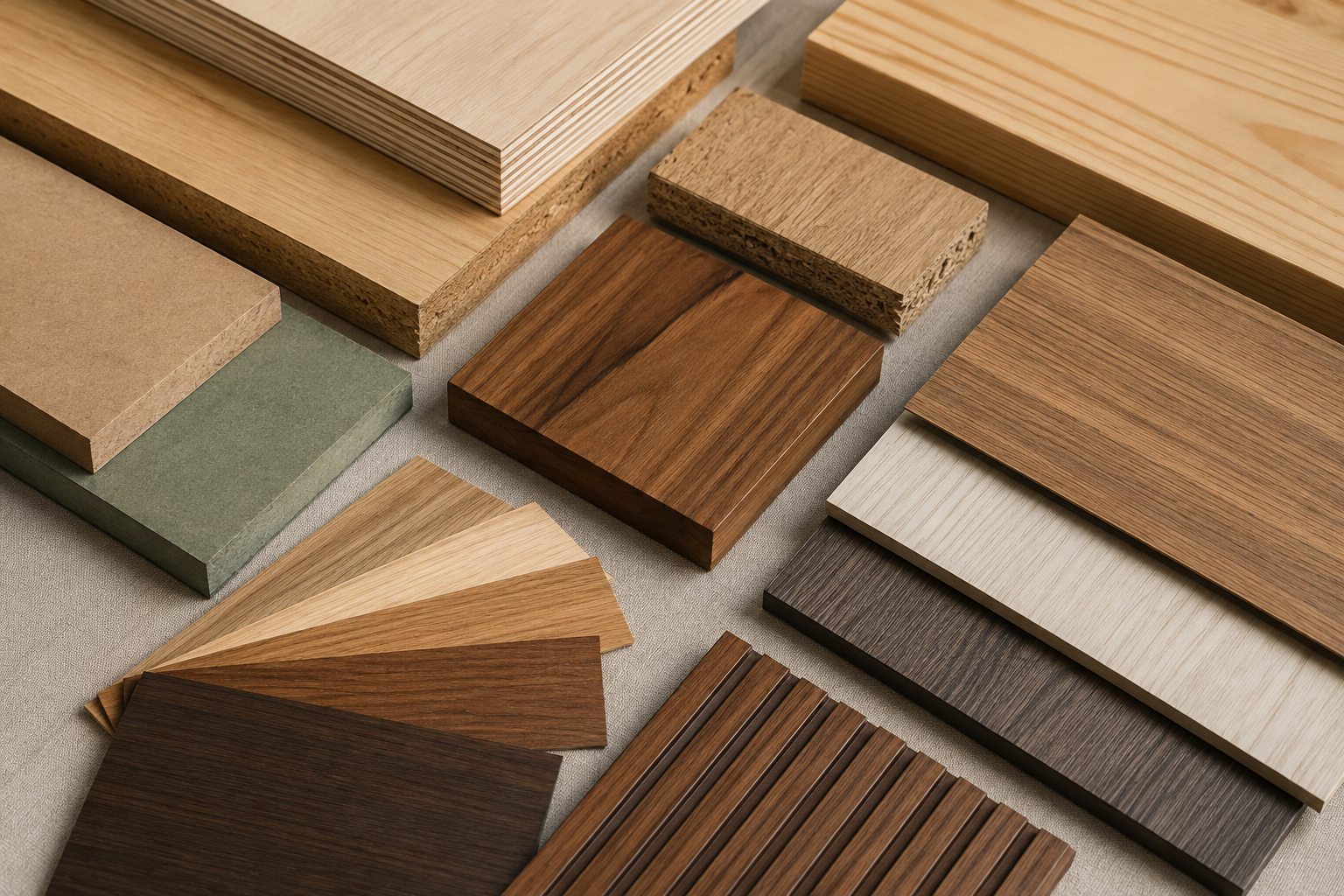
From plywood and MDF to veneers, laminates, WPC, and particle boards, there are several materials used in furniture, wardrobes, kitchens, wall panelling, doors, and storage units.
So, what are these materials, and why do interior designers choose one over another?
Let’s break it down.
1. Solid Wood
Solid wood is natural timber that has been cut and processed into usable boards. Common varieties include teak, oak, walnut, ash, and pine.
It is often chosen for its natural grain, strength, and premium appearance. Every piece can have slightly different knots, grains, and colour variations, giving furniture a unique character.
Commonly used for:
- Dining tables
- Beds
- Coffee tables
- Chairs
- Doors
- Premium furniture
Why choose it?
Solid wood can last for decades when properly maintained and can often be sanded, polished, or refinished over time.
The downside is its higher cost and its tendency to expand or contract with changes in humidity.
2. Plywood
Plywood is one of the most commonly used materials in residential interiors. It is made by bonding multiple thin layers of wood veneer together, with the grain direction alternating between layers.
This construction gives plywood good strength and dimensional stability.
Commonly used for:
- Kitchen cabinets
- Wardrobes
- Beds
- TV units
- Storage units
- Built-in furniture
Why choose it?
Plywood offers a good balance between strength, durability, and cost. It also has good screw-holding properties, making it suitable for furniture construction.
Different grades of plywood are designed for different applications, so the appropriate grade should always be selected based on the location and expected exposure to moisture.
3. MDF
MDF, or Medium-Density Fibreboard, is an engineered wood product made from wood fibres and resin that are compressed into boards.
Unlike natural wood, MDF has a very smooth and uniform surface, which makes it particularly useful when a painted or routed finish is required.
Commonly used for:
- Wall panelling
- Decorative mouldings
- Wardrobe shutters
- Cabinet fronts
- Painted furniture
Why choose it?
MDF is easy to cut, shape, and paint. It is also generally more affordable than solid wood.
However, standard MDF isn’t ideal for areas exposed to significant moisture. Moisture-resistant MDF is available for applications where additional protection is required.
4. HDF
HDF, or High-Density Fibreboard, is similar to MDF but is manufactured at a higher density.
Its harder and denser structure makes it useful for applications where a strong, smooth board is required.
Commonly used for:
- Flooring
- Door skins
- Furniture components
- Decorative panels
- Backing boards
HDF is particularly popular in flooring because of its density and ability to provide a stable base for decorative finishes.
5. Particle Board
Particle board is made from wood particles, chips, and resin that are compressed into sheets.
It is generally considered a more economical option compared with materials such as plywood.
Commonly used for:
- Ready-to-assemble furniture
- Budget wardrobes
- Shelving
- Modular furniture
- Storage units
Why choose it?
Its biggest advantage is affordability. It also has a relatively uniform surface and is lightweight.
However, it generally has lower strength and moisture resistance than good-quality plywood, so it needs to be used appropriately.
6. Veneer
Veneer is slightly different from the other materials on this list because it is not a board by itself.
It is a thin layer of real wood that is applied over a core material, such as plywood or MDF.
This allows you to achieve the appearance and natural grain of premium wood without making the entire piece from solid timber.
Commonly used for:
- TV units
- Wardrobes
- Wall panels
- Doors
- Premium cabinetry
- Furniture
Why choose it?
Veneer provides an authentic wood appearance and natural grain patterns. It can also be finished in different stains and polishes to achieve different looks.
One important distinction: natural veneer is real wood, while wood-finish laminate is a manufactured decorative surface.
7. Laminate
Laminate is a manufactured decorative surface that can imitate wood, stone, marble, concrete, and many other materials.
Wood-finish laminates are extremely popular in modern interiors because they provide a consistent appearance and are relatively easy to maintain.
Commonly used for:
- Kitchen cabinets
- Wardrobes
- TV units
- Study tables
- Storage units
- Modular furniture
Why choose it?
Laminate offers a huge variety of colours, textures, patterns, and finishes. It is also relatively easy to clean and is well suited to everyday use.
For homeowners looking for a practical finish with a wood-like appearance, laminate is often a popular choice.
8. Blockboard
Blockboard is made by placing strips of solid wood between layers of veneer.
It is relatively lightweight and can provide good stability for certain applications.
Commonly used for:
- Doors
- Long shelves
- Tables
- Partitions
- Certain types of cabinetry
The quality of blockboard can vary, so construction, core quality, and intended application should be considered before choosing it.
9. WPC
WPC, or Wood-Plastic Composite, combines wood-based material with polymers to create a composite board.
It is particularly useful in areas where moisture can be a concern.
Commonly used for:
- Bathroom vanities
- Wall panelling
- Partitions
- Selected cabinetry
- Moisture-prone areas
Why choose it?
WPC offers good moisture resistance compared with many conventional wood-based boards. Depending on the product specification, it can also offer resistance to termites and other common problems associated with traditional wood-based materials.
10. PVC Foam Board
PVC foam board is a synthetic material rather than an actual wood product. However, it is often considered alongside engineered boards when planning interiors.
It is particularly useful in wet or moisture-prone environments.
Commonly used for:
- Bathroom cabinets
- Partitions
- Wall applications
- Wet-area furniture
Why choose it?
PVC foam boards are lightweight, easy to clean, and highly resistant to moisture and rot.
Which Material Should You Choose?
There is no single “best” material for every part of your home.
| Material | Best Used For | Key Advantage |
|---|---|---|
| Solid Wood | Premium furniture, doors | Natural beauty |
| Plywood | Kitchens, wardrobes, furniture | Strength and stability |
| MDF | Panelling, painted furniture | Smooth finish |
| HDF | Flooring, dense panels | High density |
| Particle Board | Budget furniture | Affordability |
| Veneer | Premium furniture, cabinetry | Real wood appearance |
| Laminate | Modular furniture | Easy maintenance |
| Blockboard | Doors, shelves | Lightweight construction |
| WPC | Moisture-prone areas | Moisture resistance |
| PVC Foam Board | Wet areas | Water resistance |
The Right Material Depends on the Application
When choosing materials for your interiors, don’t select them purely based on how they look.
A kitchen, for example, has very different requirements from a bedroom wardrobe. A bathroom vanity faces moisture, while a living-room TV unit may be more focused on appearance and detailing.
Consider:
- Strength and durability
- Moisture exposure
- Termite resistance
- Surface finish
- Maintenance requirements
- Budget
- Thickness
- Hardware compatibility
- Expected usage
The material hidden inside your furniture is just as important as the finish you see outside.
Final Thoughts
Modern interiors are rarely made using just one type of wood or wood-like material. Instead, designers combine different materials depending on the purpose, location, finish, and budget.
Solid wood brings natural character. Plywood provides strength and versatility. MDF works beautifully for smooth and decorative finishes. Veneer gives you the authentic appearance of natural wood, while laminates offer practicality and variety. For moisture-prone areas, materials such as WPC and PVC foam board can provide additional protection.
The key isn’t simply choosing the most expensive material.
It’s choosing the right material for the right space so your interiors don’t just look beautiful on day one, but continue to perform well for years to come.