
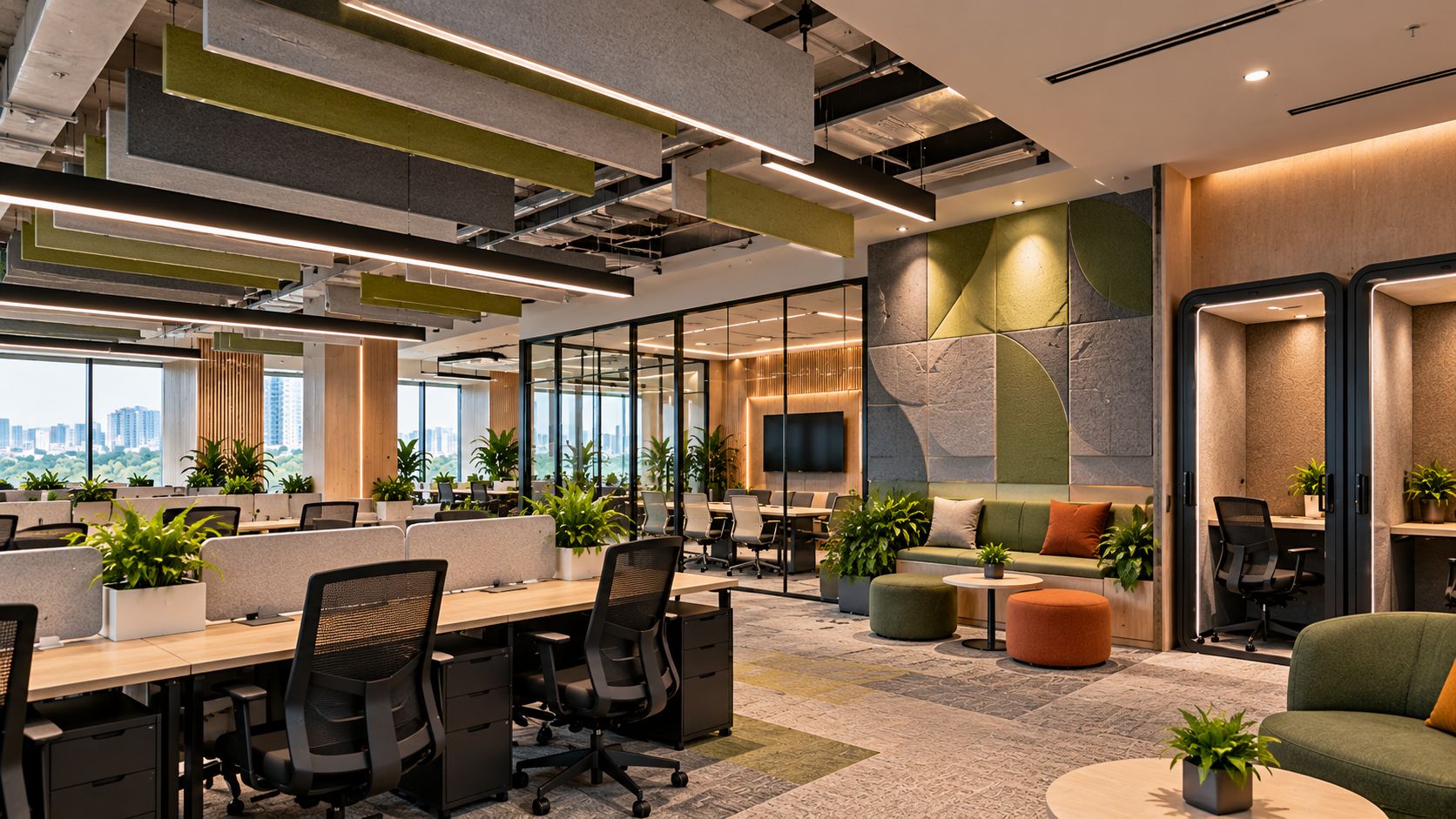
Open-plan offices are designed to encourage collaboration, improve communication, and make better use of available workspace. However, they also come with one major challenge: noise.
Conversations, phone calls, video meetings, keyboard sounds, office equipment, and constant movement can make an open office uncomfortable and distracting.
For employees who need to concentrate, even ordinary workplace conversations can become a productivity problem.
This is where office acoustics become important.
A well-designed acoustic environment helps control noise, reduce distractions, improve speech privacy, and create a more comfortable workplace without necessarily compromising the open-office layout.
Whether you’re designing a new office, renovating an existing workspace, or dealing with noise complaints from employees, the right acoustic solutions can make a significant difference.
In this guide, we’ll explore why open offices become noisy, which acoustic treatments actually work, how office acoustic panels help, and how to create a quieter workspace without completely redesigning your office.
1. Why Are Open Offices So Noisy?
Open-plan offices typically have fewer enclosed walls and partitions than traditional office layouts.
While this improves visibility and communication, it also allows sound to travel more freely across the workspace.
Some common sources of office noise include:
1. Employee Conversations
Discussions between colleagues can travel across workstations, especially in offices with hard flooring, exposed ceilings, and limited acoustic treatment.
2. Phone Calls and Video Meetings
Employees attending online meetings or making frequent business calls can create continuous background noise.
3. Office Equipment
Printers, scanners, air-conditioning systems, and other equipment contribute to the overall noise level.
4. Movement and Foot Traffic
People walking between workstations, meeting rooms, reception areas, and pantry spaces create additional sound.
5. Sound Reflection
Hard surfaces such as glass, concrete, tiles, and exposed ceilings reflect sound instead of absorbing it.
When multiple reflective surfaces are present, sound can bounce around the office, making conversations louder and more difficult to ignore.
The result is an environment where employees struggle to concentrate, even when nobody is intentionally making excessive noise.
2. How Does Office Noise Affect Employee Productivity?
Office noise is not simply an inconvenience. Poor acoustic conditions can affect how employees experience and use their workplace.
Some common problems include:
- Difficulty concentrating on complex tasks
- Frequent interruptions during work
- Reduced speech privacy
- Difficulty hearing colleagues during meetings
- Increased distraction during video calls
- Employee frustration and workplace fatigue
For businesses with teams working in finance, technology, consulting, customer support, and creative services, a noisy workspace can become particularly challenging.
A well-designed office should support both collaboration and concentration.
The goal is not to eliminate every sound. It is to control unwanted noise and ensure that different activities can happen comfortably within the same workspace.
3. Office Acoustic Panels: What Are They and How Do They Work?
<AsyncImage query=”modern office interior wall mounted acoustic felt panels geometric sound absorbing wall treatment” aspectRatio=”16:9″ width=”100%”/>
Office acoustic panels are specially designed materials that absorb sound energy and reduce sound reflections within a room.
They are commonly installed on walls, ceilings, and sometimes as freestanding partitions.
Unlike ordinary decorative wall panels, acoustic panels are designed using sound-absorbing materials such as:
- Polyester acoustic felt
- Fabric-wrapped mineral wool
- Fibreglass acoustic panels
- Acoustic foam
- Wood-wool acoustic boards
- Perforated acoustic timber systems
These materials help reduce reflected sound and improve the acoustic comfort of an office.
How do acoustic panels work?
When sound waves hit a hard surface, much of the sound energy reflects back into the room.
Acoustic panels use porous or specially designed materials to absorb a portion of that sound energy.
This helps reduce reverberation, which is the persistence of sound after the original source stops.
For example, installing acoustic panels in a large meeting room can make conversations clearer by reducing excessive echo.
Important: Acoustic panels primarily absorb sound within a space. They do not automatically soundproof a room or prevent sound from travelling between different areas.
For actual sound isolation, you need additional measures such as sealed doors, properly constructed partitions, insulation, and appropriate acoustic detailing.
4. Seven Acoustic Solutions That Actually Work in Open Offices
There is no single solution that works for every office.
The best acoustic strategy combines different materials and treatments depending on the source of noise, office layout, ceiling height, and employee requirements.
Here are seven practical solutions.
Solution 1: Install Wall-Mounted Acoustic Panels
<AsyncImage query=”contemporary corporate office meeting room decorative fabric acoustic wall panels wood finish” aspectRatio=”16:9″ width=”100%”/>
Wall-mounted acoustic panels are one of the most practical ways to improve sound absorption in offices.
They are particularly useful in:
- Meeting rooms
- Conference rooms
- Open-plan workspaces
- Discussion areas
- Training rooms
- Reception areas
These panels are available in different colours, shapes, sizes, and finishes.
You can also integrate them into the office’s overall interior design.
Why they work:
They absorb reflected sound and help reduce reverberation, making conversations more comfortable and meetings easier to follow.
Design recommendation: Install acoustic panels strategically on large reflective wall surfaces rather than covering every wall without an acoustic assessment.
Solution 2: Use Acoustic Ceiling Panels and Baffles
<AsyncImage query=”modern open office suspended acoustic ceiling baffles felt panels linear ceiling installation” aspectRatio=”16:9″ width=”100%”/>
Ceilings are often overlooked when designing office acoustics.
However, in open-plan workspaces, sound can travel across large areas through open ceiling zones.
Acoustic ceiling panels and suspended baffles help absorb sound from different parts of the office.
Common options include:
- Suspended acoustic baffles
- Ceiling clouds
- Acoustic ceiling tiles
- Hanging felt panels
- Acoustic rafts
These solutions are particularly effective in offices with high ceilings or exposed industrial ceilings.
Why they work:
They increase the amount of sound-absorbing surface area available in the office, helping control reflected sound and reverberation.
Design recommendation: Consider suspended acoustic baffles above workstation clusters, collaboration zones, and large common areas.
Solution 3: Install Acoustic Desk Dividers
<AsyncImage query=”modern open plan office desks with acoustic fabric privacy desk divider screens” aspectRatio=”16:9″ width=”100%”/>
Desk dividers are useful when multiple employees work close to each other.
These panels are generally installed between workstations to create partial separation.
They can help:
- Reduce direct sound transmission between nearby employees
- Improve visual privacy
- Create a sense of personal workspace
- Reduce distractions from neighbouring desks
Common materials include acoustic felt, fabric-wrapped boards, and other sound-absorbing materials.
Why they work:
Desk dividers can interrupt direct sound paths between nearby workstations and absorb some sound, depending on their height, material, and placement.
However, they cannot completely block conversations in an open office.
Design recommendation: Choose dividers that provide sufficient coverage without making the workspace feel visually closed or reducing natural light.
Solution 4: Create Dedicated Phone Booths and Quiet Rooms
<AsyncImage query=”modern office acoustic phone booth enclosed private meeting pod glass door felt interior” aspectRatio=”16:9″ width=”100%”/>
One of the biggest noise problems in hybrid offices comes from employees attending video meetings and business calls.
Instead of expecting everyone to make calls quietly at their desks, businesses can introduce dedicated phone booths and enclosed focus rooms.
These spaces can be used for:
- Private phone calls
- Video conferences
- Confidential discussions
- Online interviews
- Individual focused work
Why they work:
Properly designed enclosed rooms separate noisy activities from the main workspace.
For better performance, pay attention to door seals, wall construction, ceiling details, ventilation noise, and acoustic treatment.
Design recommendation: For teams with frequent online meetings, provide a combination of individual phone booths and small enclosed meeting rooms.
Solution 5: Choose Acoustic Flooring and Carpet Tiles
<AsyncImage query=”modern corporate office carpet tile flooring open workspace acoustic interior design” aspectRatio=”16:9″ width=”100%”/>
Flooring has an important role in controlling impact noise and the overall sound environment.
Hard surfaces such as ceramic tiles, stone, and polished concrete can create a reflective environment.
Carpet tiles and suitable acoustic flooring systems can help reduce footfall noise and improve comfort.
Common options include:
- Commercial carpet tiles
- Acoustic underlay systems
- Rubber flooring
- Resilient vinyl flooring with suitable underlay
Why they work:
Soft flooring materials reduce impact sounds from footsteps, chair movement, and other activities.
They can also contribute to reducing sound reflections within the workspace.
Design recommendation: Consider carpet tiles in workstation areas and meeting rooms, while using durable hard flooring in reception areas, pantries, and high-traffic zones.
Solution 6: Introduce Acoustic Zoning
<AsyncImage query=”modern office interior acoustic zoning quiet work area collaborative lounge glass meeting rooms plants” aspectRatio=”16:9″ width=”100%”/>
Sometimes the problem is not the amount of noise but where different activities are happening.
For example, placing a collaborative discussion area directly beside a quiet workstation zone can create unnecessary distractions.
Acoustic zoning involves organising the office according to different noise levels and activities.
A practical arrangement could include:
- Quiet zones for focused work
- Collaboration zones for group discussions
- Enclosed meeting rooms for calls
- Social zones near the pantry
- Reception areas near the entrance
Why it works:
It separates activities that generate noise from areas where employees require concentration.
This can improve the acoustic experience without requiring extensive construction.
Design recommendation: Place high-activity areas away from focused workstations and use partitions, furniture, and acoustic treatments to create clear boundaries.
Solution 7: Use Sound Masking Systems
Sound masking is a technology-based approach to managing office noise.
It uses specially designed speakers to distribute a controlled background sound across a workspace.
The purpose is to reduce the intelligibility of conversations from a distance, making nearby speech less distracting.
Sound masking systems are particularly useful in:
- Large open-plan offices
- Shared workspaces
- Reception areas
- Customer service environments
- Offices requiring greater speech privacy
Why they work:
A properly calibrated system raises the background acoustic level in a controlled manner, reducing the contrast between conversations and the surrounding environment.
It does not eliminate noise or provide soundproofing.
Design recommendation: Work with an acoustic specialist to determine suitable speaker placement and sound levels. Poorly configured systems can become another source of distraction.
5. Acoustic Panels vs Soundproofing: What’s the Difference?
This is one of the most important distinctions when planning office acoustics.
Many businesses assume that installing acoustic panels will prevent conversations from travelling between rooms.
However, sound absorption and sound isolation are two different things.
| Comparison | Acoustic Treatment | Soundproofing / Sound Isolation |
|---|---|---|
| Primary purpose | Reduce sound reflections | Reduce sound transmission |
| Main benefit | Less echo and reverberation | Greater separation between spaces |
| Common materials | Acoustic felt, fabric panels, baffles | Insulated partitions, sealed doors, specialist assemblies |
| Typical installation | Walls and ceilings | Walls, doors, floors and ceilings |
| Best suited for | Open offices and meeting rooms | Private cabins and confidential rooms |
What are NRC and STC ratings?
Two technical terms are useful when selecting acoustic products.
NRC (Noise Reduction Coefficient):
NRC indicates how much sound a material absorbs, based on standardised laboratory testing. It is generally expressed on a scale from 0 to 1.
A higher NRC generally indicates greater sound absorption under the test conditions.
STC (Sound Transmission Class):
STC is a rating used to describe how well a building partition or assembly reduces airborne sound transmission under standardised testing.
A higher STC generally indicates better airborne sound isolation.
Remember that an individual material’s rating does not automatically represent the performance of the complete installed wall, ceiling, door, or partition assembly.
If your goal is to reduce echo, acoustic panels may be appropriate.
If your goal is to prevent confidential conversations from being heard outside a meeting room, you need a properly designed sound-isolating construction system.
6. How to Choose the Right Acoustic Panels for Your Office
Not every acoustic panel is suitable for every workspace.
Before purchasing, consider the following factors.
1. Material
Common options include polyester felt, fabric-wrapped panels, fibreglass, mineral wool, and perforated acoustic timber.
Choose materials based on performance, durability, fire-safety requirements, and maintenance.
2. Thickness and Construction
Panel thickness, density, backing, air gaps, and installation method influence acoustic performance.
A thicker panel is not automatically better in every situation. Compare tested acoustic performance rather than relying only on thickness.
3. NRC Rating
Check the product’s tested NRC rating or relevant frequency-specific absorption data.
The right specification depends on the room, sound frequencies, and acoustic objectives.
4. Design and Aesthetics
Acoustic panels are available in multiple finishes.
You can choose colours and textures that complement the office’s interior design.
5. Installation Location
Identify whether the office needs wall-mounted panels, ceiling baffles, desk dividers, or enclosed acoustic spaces.
Correct placement is often more important than simply installing more panels.
6. Fire and Safety Compliance
For commercial interiors, verify that acoustic materials meet the applicable fire-performance and building requirements.
Also consider cleaning, maintenance, and durability in high-traffic environments.
7. How Much Do Office Acoustic Panels Cost in India?
The cost of office acoustic treatment depends on the material, thickness, acoustic performance, design, size, and installation requirements.
The following are broad indicative planning ranges for the Indian market in 2026.
| Acoustic Solution | Indicative Price Range |
|---|---|
| Basic Acoustic Foam Panels | ₹100–₹300 per sq. ft. |
| Polyester Acoustic Panels | ₹150–₹450 per sq. ft. |
| Fabric-Wrapped Acoustic Panels | ₹250–₹700 per sq. ft. |
| Premium Decorative Acoustic Panels | ₹400–₹1,000+ per sq. ft. |
| Acoustic Ceiling Baffles | ₹300–₹900+ per sq. ft. |
| Acoustic Desk Dividers | ₹1,500–₹6,000+ per unit |
These are indicative budget ranges, not verified supplier quotations. Prices can vary based on product specifications, brand, panel dimensions, installation hardware, quantity, and project location. Some suppliers quote by panel or unit rather than square foot.
Additional costs may apply for:
- Acoustic assessment
- Installation labour
- Custom fabrication
- Ceiling suspension systems
- Acoustic doors
- Specialised sound-isolating partitions
For larger office projects, requesting a detailed bill of quantities and product test reports can help you compare quotations more accurately.
8. Example: Acoustic Planning for a 50-Person Open Office
Let’s consider a 3,000 sq. ft. office with approximately 50 employees.
The workspace includes:
- 35 shared workstations
- Two meeting rooms
- One conference room
- One reception area
- One pantry
- One collaborative lounge
Instead of installing acoustic panels throughout the entire office, you can prioritise areas based on noise levels and usage.
An illustrative acoustic improvement plan could look like this:
| Office Area | Recommended Acoustic Solution |
|---|---|
| Workstations | Desk dividers and ceiling baffles |
| Meeting Rooms | Wall panels and acoustic ceiling treatment |
| Conference Room | Wall absorption and sound-isolating partitions |
| Reception | Decorative acoustic panels |
| Collaborative Lounge | Ceiling baffles and soft furnishings |
| Focus Areas | Acoustic screens and enclosed pods |
| Pantry | Acoustic ceiling treatment and zoning |
This targeted approach can improve acoustic comfort without unnecessarily increasing the interior budget.
The actual treatment area and product specifications should be determined through a site assessment.
9. Common Acoustic Design Mistakes to Avoid
Even expensive acoustic materials may fail to solve office noise problems when they are installed incorrectly.
Here are some common mistakes businesses should avoid.
1. Installing Panels Without Identifying the Noise Problem
Before choosing materials, determine whether the main problem is echo, conversations, footfall, equipment noise, or sound transmission between rooms.
Different problems require different solutions.
2. Assuming Acoustic Panels Soundproof an Office
Absorption panels reduce reflections but do not automatically block sound from travelling through walls, doors, or ceilings.
3. Ignoring the Ceiling
In large open-plan offices, ceilings provide valuable opportunities for sound absorption.
Ignoring them can limit the effectiveness of an acoustic treatment strategy.
4. Using Too Many Hard Surfaces
Glass, polished stone, concrete, and other reflective finishes can contribute to excessive reverberation.
Balance these materials with suitable sound-absorbing surfaces.
5. Poor Placement of Meeting Rooms
Meeting rooms used for frequent video calls should not be positioned directly beside quiet workstations without adequate acoustic separation.
6. Choosing Materials Only for Appearance
Decorative panels may look attractive but might not provide the acoustic performance your office requires.
Always check the product’s tested specifications.
10. How to Create a Quieter Office Without Completely Redesigning It
If your office is already operational, you don’t necessarily need to undertake a complete renovation to improve its acoustic environment.
Start with practical improvements.
- Install acoustic panels on large reflective walls.
- Introduce ceiling baffles above workstation clusters.
- Add fabric desk dividers.
- Move printers and noisy equipment away from quiet zones.
- Introduce dedicated phone booths.
- Use carpet tiles in suitable work areas.
- Rearrange collaborative spaces away from focused workstations.
- Add soft furnishings and acoustic screens.
- Review the placement of meeting rooms.
- Consider professional sound masking where appropriate.
A phased approach allows businesses to address the biggest noise problems first and evaluate the results before investing in additional acoustic treatments.
Frequently Asked Questions (FAQs)
1. Do acoustic panels actually reduce office noise?
Yes. Acoustic panels absorb reflected sound and help reduce reverberation within a room. They can make conversations more comfortable and improve acoustic conditions, but they do not completely block sound transmission.
2. What are the best acoustic panels for an office?
Polyester felt panels, fabric-wrapped mineral wool panels, fibreglass panels, and suitable perforated acoustic systems are common choices. The best option depends on the acoustic requirements, fire-safety specifications, budget, and design.
3. How do I soundproof an open-plan office?
Complete sound isolation in an open-plan office is difficult because there are few enclosed barriers. A practical solution combines acoustic zoning, enclosed meeting rooms, sealed doors, sound-isolating partitions, desk dividers, and sound absorption.
4. Are acoustic panels better than acoustic foam?
It depends on the application. Both can absorb sound, but their performance, durability, appearance, fire properties, and installation requirements differ. Commercial-grade acoustic panels are often preferred in offices because they offer more design and specification options.
5. How many acoustic panels does an office need?
There is no fixed number. It depends on room dimensions, ceiling height, surface materials, existing reverberation, panel performance, and the desired acoustic outcome. An acoustic assessment can help determine the required quantity and placement.
6. Can acoustic panels be installed on glass office partitions?
Yes. Suitable acoustic products can be installed on or alongside glass partitions using appropriate mounting systems. However, adding absorption panels does not make an ordinary glass partition soundproof.
7. What is the difference between NRC and STC ratings?
NRC measures sound absorption, while STC measures the airborne sound isolation performance of a building assembly. NRC is useful when selecting acoustic panels, while STC is relevant when designing sound-isolating walls and partitions.
8. Are acoustic panels suitable for small offices?
Yes. Small offices can benefit from wall-mounted panels, ceiling treatments, acoustic desk dividers, and enclosed phone booths. The treatment should be selected according to the specific noise problem.
9. Can acoustic treatment improve meeting room performance?
Yes. Wall and ceiling absorption can reduce reverberation, making speech clearer and improving the experience of both in-person and video meetings.
10. How much does office acoustic treatment cost in India?
Basic acoustic treatments may start around ₹100–₹300 per sq. ft., while premium decorative and specialised solutions can cost considerably more. The final investment depends on material specifications, coverage, installation, and project requirements.
Conclusion: Better Office Acoustics Create Better Workspaces
An open office should encourage communication without making concentration difficult.
The right acoustic design helps businesses achieve this balance by controlling unwanted sound, reducing reverberation, improving speech privacy, and creating dedicated spaces for different activities.
From wall-mounted acoustic panels and ceiling baffles to sound-isolating meeting rooms and quiet focus pods, there are several ways to improve office acoustics without compromising the overall interior design.
The key is to understand where noise originates and select solutions that address the actual problem.
Whether you’re planning a new office or upgrading an existing workspace, investing in acoustic planning can make your workplace more comfortable and functional.
Planning to improve your office acoustics?
Get your workspace evaluated and explore acoustic panels, ceiling treatments, sound-isolating partitions, and customised acoustic solutions designed around your team’s requirements.